Some clients need more than talk.
You've known that. Now there's a path forward.
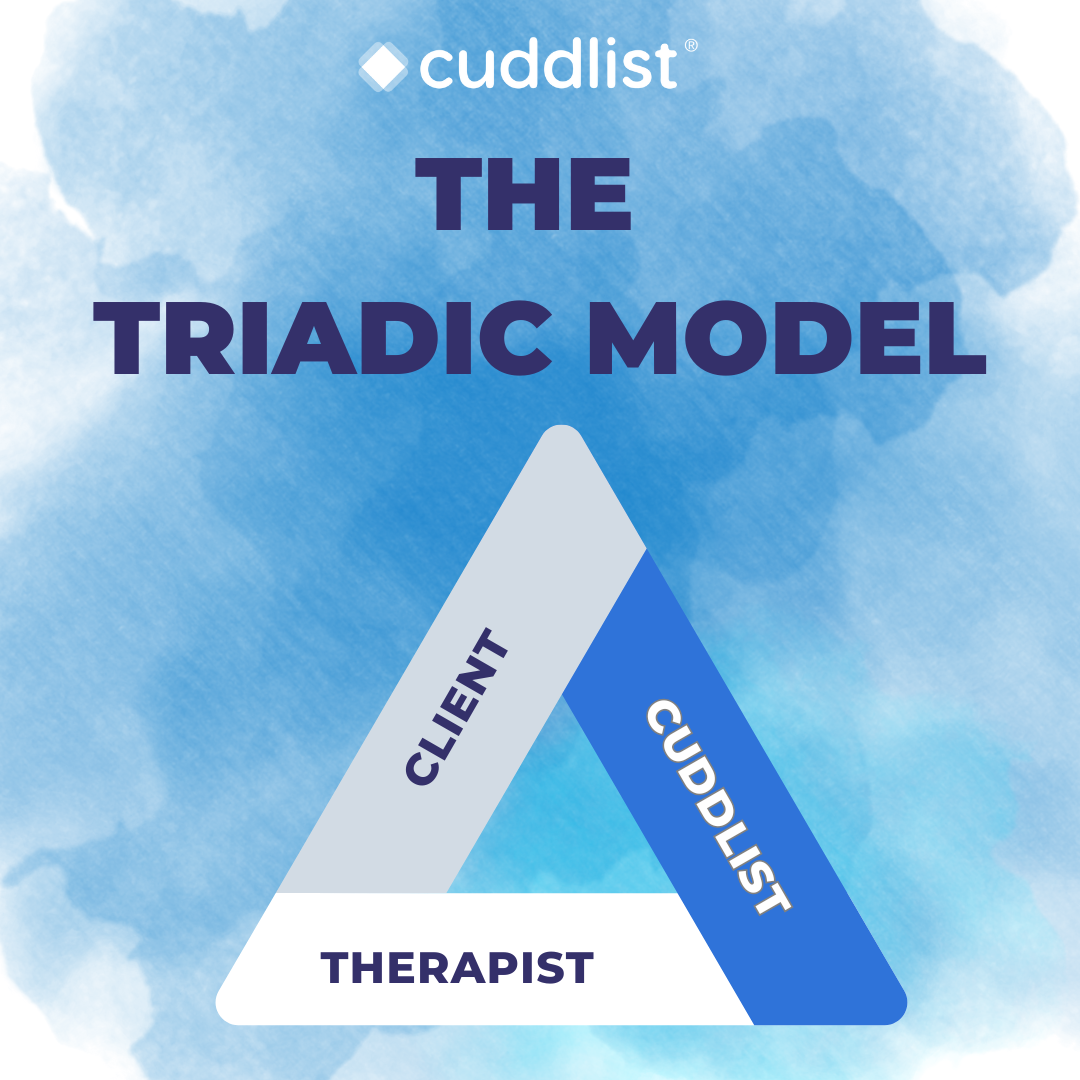
The Triadic Model Training gives therapists, counselors, and coaches the frameworks to collaborate confidently with Cuddlist practitioners — referring safely, working alongside touch professionals, and expanding what's possible for your clients.
Self-paced. Start immediately. Work through it on your own schedule.
WHat you'll walk away with
Practical frameworks you can use right away.
By the end of this training you'll have concrete tools for how to refer, how to collaborate, and how to hold your clinical role within a triadic relationship — whether you engage minimally or build a fully integrated care team.
✔️ Navigate transference, ethics, risk tolerance, & levels of engagement in collaborative care contexts
✔️ Refer clients to Cuddlist practitioners with clinical confidence & document why it's therapeutically necessary
✔️ Collaborate in triadic sessions where the scope and role of both the clinician & the touch practitioner are clear & defined
✔️ Build a two-way referral network with your local Cuddlists & touch workers that expands your reach & effectiveness.
✔️ Help clients generalize the emotional regulation & relational skills from cuddle sessions into their daily lives
✔️ Identify which clients are most likely to benefit from touch-based support and which situations aren't a great fit
Ready to expand your business and see your clients bloom?
WHO IS THIS FOR
Built for clinicians who work with the whole person.
Therapists and counselors who want to safely refer clients to touch work practitioners with clear criteria & clinical confidence.
Clinicians who've had clients ask about cuddle therapy & weren't sure how to respond evaluate it, or stay involved.
Coaches & somatic practitioners ready to explore how the triadic model can expand what's possible in their practice.
Any helping professional curious about collaboration where you stay engaged rather than hand off and hope.
What you need to know
Frequently Asked Questions
Who is this training for?
This course is designed for licensed therapists, counselors, and clinicians who want to expand their clinical toolkit to include collaborative care with trained cuddle practitioners. If you're already working in somatic, trauma-informed, or relational healing spaces, this training will feel like a natural next step.
Do I need any prior experience with touch-based or somatic work?
Not at all. The course builds from foundational concepts, so you don't need a somatic background to get started.
What exactly will I learn?
You'll come away with a solid understanding of the Triadic Model — what it is, where it came from, and how it works in practice. That includes the Cuddlist Method, how to identify appropriate clients for this kind of collaborative care, how referrals work, what triadic meetings look like, and how to think through risk and clinical judgment in this context.
Is this training professionally credible?
Yes. The Triadic Model has roots in the collaborative care tradition going back to Masters and Johnson, and Cuddlist has been developing and refining this framework for over a decade. The course is grounded in trauma-informed, consent-based principles that align with contemporary clinical ethics.
Does this course offer CEUs?
This course does not currently offer CEUs. We will update when that changes.
How is the course delivered?
It's entirely self-paced and online. You'll move through a series of modules that include both text and video, so you can engage with the material in whatever way works best for you. There are no live sessions or scheduled calls required.
How long will it take to complete?
That's really up to you. The course is designed so you can move through it at your own pace — some clinicians complete it in a weekend, others take longer. You'll have continued access once enrolled, so there's no pressure to rush.
What does it cost?
The course is $199.
Will this change how I practice?
It might — in the best way. Many clinicians find that learning about the Triadic Model opens up new options for clients who have plateaued in traditional talk therapy or who are specifically working on relational touch and embodiment. You're not being asked to change what you do. You're gaining a framework for knowing when and how to bring in a collaborator.
What if I'm not sure my clients are a good fit for this work?
That's exactly what this training helps you figure out. We cover client selection, referral protocols, and how to assess whether the Triadic Model makes sense for a given person's goals and history. You'll leave with a clearer sense of who this serves well — and who it doesn't.
I'm concerned about how this might look to my licensing board. Is that addressed?
Yes, and it's a fair concern to have. The course covers the professional and ethical framework that makes this work fit well within a clinical context — including assessing your own risk profile, how to communicate about it with clients, and where it sits in relation to existing professional standards.